
The relationship between morning sunlight and sleep is a foundational pillar of human biology, intrinsically linked to the circadian rhythm that dictates our physical, mental, and behavioral changes over a 24-hour cycle. In modern society, the profound impact of natural light on our health is frequently overlooked, often replaced by artificial environments that fail to provide the necessary photic stimulation. However, understanding the intricate mechanisms through which morning light exposure influences our sleep architecture is crucial for optimizing overall well-being. Sunlight serves as the primary zeitgeber—a time-giver—that synchronizes our internal biological clock with the external solar day. When we expose ourselves to bright morning sunlight, we initiate a cascade of neurochemical events that not only promote wakefulness and alertness but also ensure a robust and restorative sleep cycle later that evening. This article looks closely at the scientific underpinnings of this relationship, exploring the specialized cells in our eyes that detect this light, the critical timing required for maximum efficacy, the differences in light intensity between indoor and outdoor environments, and the alternatives available when natural sunlight is scarce. We will examine how a mere behavioral adjustment—stepping outside shortly after waking—can profoundly recalibrate our physiological processes, leading to enhanced cognitive performance, mood stabilization, and the prevention of sleep disorders. By bridging the gap between chronobiology and daily habits, we aim to provide a comprehensive understanding of why capturing the morning sun is arguably the most potent, yet underutilized, tool for achieving optimal sleep hygiene. The journey into the science of sunlight and sleep reveals a finely tuned system, perfected over millions of years of evolution, that continues to govern our health in the modern world.
Melanopsin Ganglion Cells and the Retinal Pathway
The biological mechanism by which morning sunlight influences our sleep-wake cycle begins in the eye, specifically within a remarkable subset of photoreceptors known as intrinsically photosensitive retinal ganglion cells (ipRGCs). Discovered relatively recently compared to the more familiar rods and cones, these specialized cells play a central role in non-image-forming vision, meaning their primary function is not to help us see the world around us, but rather to detect ambient light levels and relay this critical information directly to the brain's master clock. The secret to their functionality lies in a unique photopigment called melanopsin. Unlike the photopigments in rods and cones, melanopsin is exceptionally sensitive to short-wavelength light, particularly in the blue spectrum, which peaks around 480 nanometers. This is precisely the type of light that is abundant in the morning sky.
When morning sunlight enters the eye, it strikes the retina and activates the melanopsin within the ipRGCs. This activation triggers an electrical signal that travels along a dedicated neural pathway known as the retinohypothalamic tract (RHT). The RHT acts as a high-speed fiber-optic cable, transmitting the photic information directly from the retina to the suprachiasmatic nucleus (SCN), a tiny region located in the hypothalamus that serves as the body's central circadian pacemaker. The SCN is essentially the conductor of the body's biological symphony, orchestrating the timing of various physiological processes, including core body temperature fluctuations, hormone secretion, and, importantly, the sleep-wake cycle.
Upon receiving the signal that bright, blue-enriched light is present, the SCN springs into action. It immediately sends inhibitory signals to the pineal gland, effectively halting the production of melatonin, the hormone responsible for promoting sleep. Simultaneously, it stimulates the adrenal glands to release cortisol, a hormone that increases alertness, energy levels, and metabolic activity. This rapid shift in hormonal balance is what shakes off the grogginess of sleep inertia and prepares the body and mind for the demands of the day. The sensitivity of the melanopsin ganglion cells is finely tuned to the intensity and spectral composition of natural daylight, making them the perfect biological sensors for dawn. Furthermore, these cells are uniquely adapted to integrate light exposure over time, meaning they do not just respond to a brief flash of light, but require sustained exposure to send a durable signal to the SCN. This cumulative activation ensures that the biological clock is not easily tricked by transient environmental changes, but instead responds to the genuine transition from night to day. Understanding the retinal pathway and the critical role of ipRGCs underscores the fact that morning light exposure is not merely a psychological boost, but a profound physiological requirement for maintaining circadian alignment and ensuring that the biological clock remains precisely synchronized with the Earth's rotation.
Timing is Everything: The 30-Minute Morning Window
While the physiological mechanisms for detecting light are robust, the timing of this exposure is arguably the most critical factor in establishing a healthy circadian rhythm. Chronobiologists emphasize that the benefits of morning sunlight are heavily dependent on when it is received, with a crucial "window of opportunity" occurring within the first 30 to 60 minutes after waking. This specific timing is essential because the suprachiasmatic nucleus (SCN) is most responsive to phase-shifting stimuli during this early morning period. When light exposure occurs shortly after waking, it provides a strong anchoring signal—a phase advance—that definitively tells the biological clock that the day has begun. This early signal is vital for preventing the natural tendency of the human circadian rhythm to drift longer than 24 hours.
If light exposure is delayed by several hours, the phase-shifting effect is significantly diminished, and the biological clock may remain in a state of confusion, leading to prolonged grogginess and a misalignment of hormonal rhythms. The 30-minute morning window is particularly critical for resetting the cortisol awakening response (CAR). The CAR is a natural, rapid increase in cortisol levels that occurs immediately after waking, peaking at around 30 to 45 minutes. Exposure to bright sunlight during this window enhances the amplitude of the CAR, ensuring a robust surge of energy and alertness that sustains cognitive function and mood throughout the morning. Conversely, missing this window can result in a blunted cortisol response, leaving individuals feeling lethargic and unmotivated.
Furthermore, the timing of morning light exposure sets the phase for the entire 24-hour cycle, effectively determining when you will feel sleepy later that night. A strong light signal immediately after waking starts a biological timer, ensuring that melatonin production will commence approximately 12 to 14 hours later. By consistently exposing oneself to sunlight within this critical 30-minute window, individuals can establish a highly predictable and consolidated sleep-wake cycle. This behavioral practice is particularly important in the modern era, where irregular sleep schedules and extended periods spent indoors can easily disrupt circadian alignment. Making the effort to step outside, even for just 10 to 15 minutes immediately after getting out of bed, is a simple yet profoundly effective strategy for leveraging the body's natural physiological rhythms. This practice is especially critical for individuals who suffer from chronic fatigue, shift work sleep disorder, or general insomnia, as it provides the strongest natural cue to realign a disjointed biological clock. By prioritizing this morning window, individuals can optimize alertness during the day, stabilize their metabolic processes, and facilitate deep, restorative sleep at night.
Lux Thresholds: Outdoors vs. Indoors
To fully appreciate why morning sunlight is unparalleled in its ability to regulate the circadian rhythm, one must understand the concept of light intensity, measured in lux. Lux is the standard unit of illuminance, representing the amount of light that falls on a given surface area. When it comes to stimulating the melanopsin-containing intrinsically photosensitive retinal ganglion cells (ipRGCs) and signaling the suprachiasmatic nucleus (SCN), not all light is created equal. The human biological clock requires a significant threshold of light intensity to trigger a robust physiological response, and the disparity between outdoor natural light and indoor artificial light is staggering.
On a clear, sunny morning, the light intensity outdoors can easily reach between 50,000 and 100,000 lux. Even on an overcast or cloudy day, the ambient light outside typically ranges from 1,000 to 10,000 lux. In stark contrast, typical indoor lighting—whether in a home, office, or classroom—rarely exceeds 300 to 500 lux. This massive discrepancy is often imperceptible to our conscious vision, as the human eye is incredibly adept at adapting to different lighting environments, creating the illusion that a well-lit room is nearly as bright as the outdoors. However, the ipRGCs, which act as the body's light meters, are not so easily fooled. They require the high lux levels provided by natural sunlight to effectively suppress melatonin and stimulate the alerting mechanisms of the brain.
Sitting by a window can provide more light than being deep within a room, but the glass itself filters out a significant portion of the beneficial wavelengths and reduces the overall lux intensity. Therefore, simply opening the blinds or turning on all the lights in the house is grossly insufficient for providing the circadian anchor needed in the morning. To reach the minimum threshold of roughly 1,000 to 2,500 lux required to consistently suppress melatonin and reset the SCN, direct, unobstructed exposure to the sky is necessary. This means physically stepping outside, without sunglasses, and allowing the natural light to enter the eyes. The high lux environment of the outdoors delivers the concentrated dose of photons required to maximize the activation of the retinohypothalamic tract, ensuring a decisive physiological shift. Moreover, the dynamic nature of outdoor light, with its subtle variations in intensity and spectrum as the sun rises, provides a richer, more complex signal to the circadian system than the static output of indoor bulbs. Understanding this lux differential highlights why spending the morning entirely indoors often leads to circadian disruption, cognitive fog, and suboptimal sleep quality, reinforcing the absolute necessity of getting outside to harness the true power of natural light.
Backup-light note
Use a wake-up light as a backup for dark or windowless mornings.
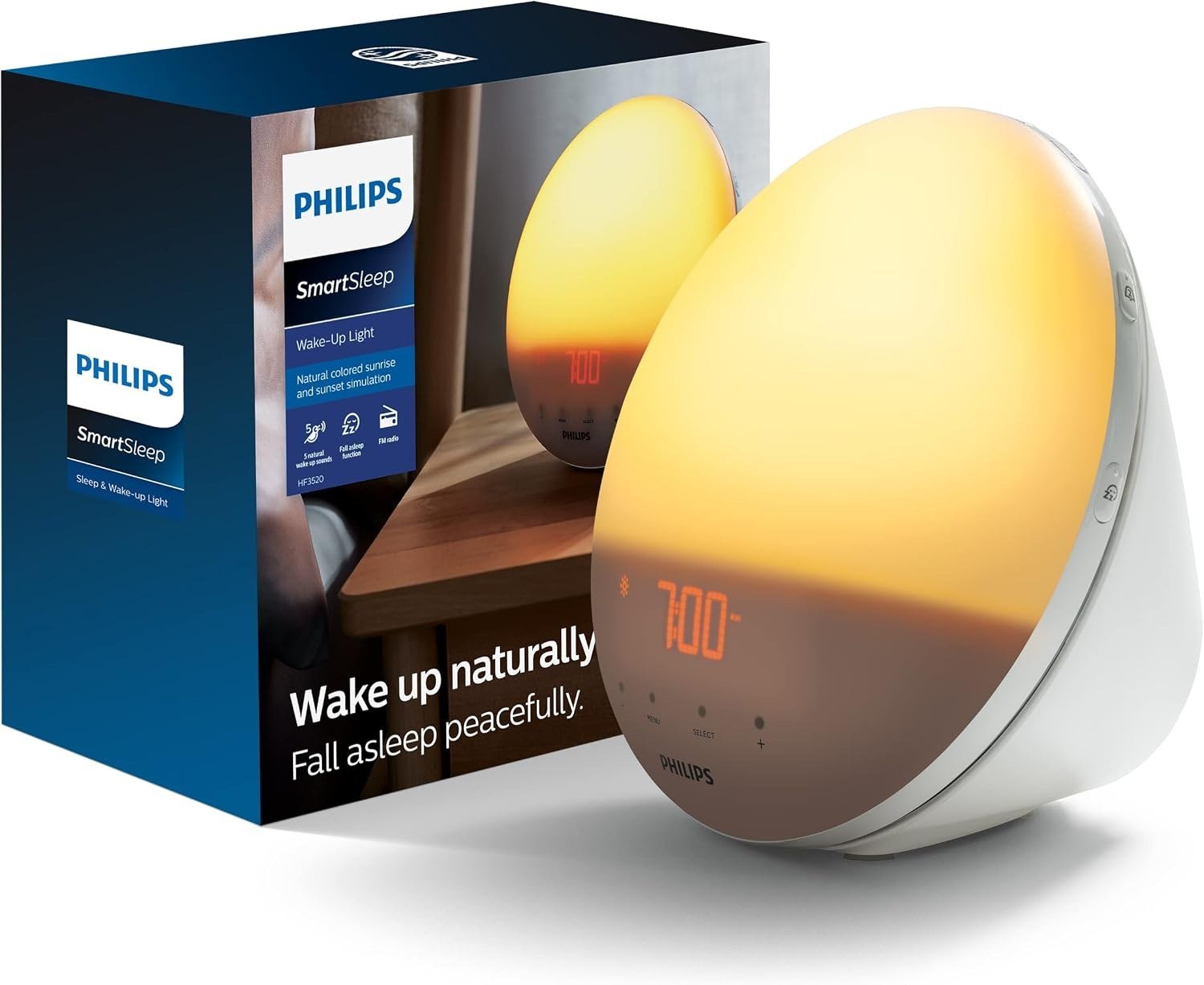
Philips SmartSleep Wake-Up Light HF3520/60
The Philips HF3520/60 is a dedicated wake-up lamp that brightens over 30 minutes through red, orange and yellow to a stated 300 lux, then plays one of five natural sounds or FM radio. It has a tap-to-snooze top, a sunset dimming mode and a reading-lamp function, and it needs no app. It suits people who want light as the wake cue and nothing to configure. It is an older design with a dated display and no white-noise library.
Only after clearly stating that outdoor morning light is the first choice.
Artificial Light Therapy During Winter Months
While the benefits of morning sunlight are unequivocal, acquiring adequate natural light exposure can become exceedingly difficult, if not impossible, during the winter months, particularly for individuals living in higher latitudes. As the days shorten and the sun rises later, many people are forced to wake up and commute to work in complete darkness. This lack of morning light deprives the circadian system of its vital zeitgeber, leading to a condition known as Seasonal Affective Disorder (SAD), characterized by lethargy, mood depression, and disrupted sleep architecture. In these scenarios, when natural sunlight is inaccessible during the critical morning window, artificial light therapy becomes an essential, science-backed intervention.
Philips SmartSleep Wake-Up Light HF3520/60
The Philips HF3520/60 is a dedicated wake-up lamp that brightens over 30 minutes through red, orange and yellow to a stated 300 lux, then plays one of five natural sounds or FM radio. It has a tap-to-snooze top, a sunset dimming mode and a reading-lamp function, and it needs no app. It suits people who want light as the wake cue and nothing to configure. It is an older design with a dated display and no white-noise library.
Light therapy involves the use of specialized devices designed to mimic the intensity and spectral composition of natural morning sunlight. These devices, often referred to as SAD lamps or light boxes, must emit a minimum of 10,000 lux to be therapeutically effective. When used consistently for 20 to 30 minutes shortly after waking, they can successfully stimulate the ipRGCs, trigger the retinohypothalamic tract, and reset the suprachiasmatic nucleus, effectively serving as a substitute for the missing morning sun. For individuals who struggle with the abrupt transition from darkness to wakefulness, a more gradual approach can also be highly beneficial. This is where specialized wake-up lights come into play. A prime example is the [[PRODUCT:philips-smartsleep-wake-up-light-hf352060]], which is engineered to simulate a natural sunrise. By gradually increasing light intensity in the bedroom before the alarm sounds, this device begins to gently suppress melatonin and stimulate the cortisol awakening response while the user is still in the final stages of sleep.
The use of artificial light therapy is not merely a comfort measure; it is a clinical tool used to maintain circadian alignment when environmental conditions are uncooperative, and it is widely recommended by sleep medicine specialists. The efficacy of these devices hinges on proper usage: they should be positioned at eye level, roughly 16 to 24 inches away, and the light must enter the eyes indirectly, without the user staring directly into the source. Furthermore, consistency is paramount; using a light box sporadically will not yield the sustained circadian benefits required to combat SAD or chronic sleep issues. By incorporating a high-lux light box or a sophisticated wake-up simulator into the morning routine, individuals can successfully combat the negative physiological effects of winter darkness. This ensures that their biological clock receives the strong, unambiguous signal it requires to initiate the day, thereby preserving mood stability, maximizing daytime energy levels, and maintaining a consolidated, healthy sleep cycle regardless of the season.
How Morning Light Sets the Evening Melatonin Timer
One of the most fascinating and counterintuitive aspects of circadian biology is the profound connection between morning behavior and evening physiology. The light you experience immediately after waking does not just dictate your alertness for the current moment; it effectively programs your body for sleep later that night. This delayed reaction is governed by the intricate relationship between the suprachiasmatic nucleus (SCN) and the pineal gland, and it centers on the precise regulation of melatonin, the hormone universally recognized as the biochemical signal for sleep. Understanding this mechanism is the key to consistent, high-quality rest.
When bright morning sunlight strikes the retina and activates the SCN, it does more than just halt the current production of melatonin. It initiates a biological timer—a countdown clock that determines when melatonin will begin to rise again in the evening. This process is often described as setting the phase of the circadian rhythm. A strong, early light signal establishes a distinct starting point for the day, ensuring that the entire 24-hour cycle is properly anchored. Approximately 12 to 14 hours after this morning light exposure, provided the environment is sufficiently dim, the SCN will signal the pineal gland to resume melatonin synthesis. This condition, known as dim light melatonin onset (DLMO), is the critical physiological prerequisite for feeling sleepy and initiating the sleep process.
If morning light exposure is delayed, weak, or absent—as is common when individuals wake up in dark rooms and remain indoors—the entire circadian phase is shifted later. The biological clock perceives the day as starting later, which in turn delays the onset of melatonin secretion in the evening. This delay manifests as an inability to fall asleep at the desired bedtime, a condition often diagnosed as Delayed Sleep Phase Syndrome (DSPS). Furthermore, robust morning light exposure has been shown to increase the amplitude of the circadian rhythm. This means that not only is the timing of melatonin release optimized, but the peak concentration of melatonin produced at night is also significantly higher. A larger melatonin surge results in deeper, more restorative sleep stages, increased time spent in slow-wave sleep, and fewer nocturnal awakenings. Additionally, this robust melatonin profile serves as a potent antioxidant, providing cellular repair and neuroprotection throughout the night. Therefore, the simple act of seeking out morning sunlight is perhaps the most powerful, proactive step one can take to guarantee a strong, early, and sustained release of melatonin. It is a daily investment in your biological infrastructure, paving the way for optimal sleep architecture and long-term metabolic health.
Conclusion
the relationship between morning sunlight and sleep is a profound physiological necessity, deeply ingrained in our evolutionary biology. The discovery of melanopsin-containing ganglion cells has illuminated the precise mechanisms by which natural light communicates directly with our master biological clock, the suprachiasmatic nucleus. By understanding the critical importance of the 30-minute morning window, we can harness the power of light to trigger essential hormonal shifts, suppressing melatonin and boosting cortisol to conquer sleep inertia. The massive disparity in lux levels between outdoor environments and indoor artificial lighting underscores the inescapable need to step outside to receive an adequate circadian signal. When natural light is unavailable, particularly during the dark winter months, artificial light therapy provides a vital, science-backed alternative for maintaining circadian alignment. Ultimately, realizing that morning light exposure acts as the primary catalyst for evening melatonin production fundamentally changes our approach to sleep hygiene. It shifts the focus from merely managing the evening environment to proactively programming the biological clock from the moment we wake. By prioritizing early morning sunlight, we can optimize our circadian rhythms, enhance our daytime cognitive performance, and secure the deep, restorative sleep essential for overall health, emotional resilience, and longevity.



Join the conversation
Questions and experiences are welcome. Every comment is read by a person before it appears, and your email address is never published.
No comments yet — yours would be the first.