
The alarm sounds. The immediate physiological and psychological response for millions of people worldwide is an overwhelming urge to press the snooze button, seeking just a few more precious minutes of unconsciousness. But what seems like an innocuous attempt to gently transition into the waking world is, in reality, a deeply counterproductive habit that disrupts our biological rhythms and impairs cognitive function for hours after we finally leave our beds. This phenomenon is rooted in complex interactions between our sleep architecture, neurotransmitter systems, and the endocrine system. The transition from the depths of sleep to a state of full, alert wakefulness is not a simple toggle switch; it is a highly orchestrated physiological cascade that requires precise timing and specific neurochemical shifts. When we interrupt this cascade with a blaring alarm, only to abruptly suspend it by hitting snooze, we trap our brains in a state of neurochemical limbo.
This article looks closely at the rigorous science of waking up, examining the profound negative impacts of the snooze cycle on our biology, and exploring evidence-based strategies for breaking this cycle. By understanding the intricate mechanisms of sleep inertia, the endocrinology of waking, and the critical role of the cortisol awakening response, we can begin to appreciate why our mornings feel so arduous and how we can re-engineer our waking routines for optimal physiological and psychological health. We will explore the detrimental effects of fragmented Rapid Eye Movement (REM) sleep, the chaos induced within the hypothalamic-pituitary-adrenal (HPA) axis, and the importance of transitioning from jarring acoustic shocks to gradual, light-based waking systems. Ultimately, the goal is to shift from a state of morning resistance to one of synchronized circadian alignment, empowering you to reclaim your mornings and, by extension, the trajectory of your entire day. The science clearly indicates that our modern waking habits are fundamentally misaligned with our evolutionary biology, and correcting this misalignment is the first crucial step toward optimizing our daily cognitive and physical performance.
The Endocrinology of the Snooze Button
To understand the profound disruption caused by the snooze button, one must first examine the endocrine environment of the sleeping brain, particularly during the final hours of the sleep cycle. Sleep is not a uniform state; it is a dynamic process characterized by alternating cycles of Non-Rapid Eye Movement (NREM) and Rapid Eye Movement (REM) sleep. As the night progresses, REM sleep periods become exponentially longer and more dense. During these late-night REM stages, the brain is highly active, resembling wakefulness in its electrical patterns, yet the body is paralyzed by REM atonia, a state of motor inhibition orchestrated by the brainstem to prevent us from acting out our dreams. Concurrently, the endocrine system is conducting a delicate, complex shift. The pineal gland’s secretion of melatonin, the hormone primarily responsible for initiating and maintaining sleep, begins to wane in response to the internal circadian clock governed by the suprachiasmatic nucleus (SCN) in the anterior hypothalamus. Simultaneously, the body’s core temperature begins a gradual, highly regulated ascent, and other neurochemicals associated with wakefulness begin to synthesize.
When a sudden, loud alarm intrudes upon this carefully balanced neurochemical state, it acts as an acute and severe stressor. The abrupt auditory stimulus triggers an immediate, unmitigated response from the sympathetic nervous system, often referred to as the "fight or flight" response. The amygdala, a brain region central to threat detection, registers the alarm as a potential danger, rapidly signaling the hypothalamus to activate the sympathetic nervous system and the adrenal medulla. This results in an explosive surge of catecholamines—primarily epinephrine (adrenaline) and norepinephrine (noradrenaline)—directly into the bloodstream. These circulating hormones cause a sudden, intense spike in heart rate, blood pressure, and respiratory rate, violently tearing the organism out of a resting state.
If one were to wake up and remain awake at this point, the body would eventually metabolize these stress hormones, downregulate the sympathetic nervous system, and stabilize into a normal waking rhythm. However, pressing the snooze button initiates a disastrous physiological paradox. The individual attempts to plunge back into sleep, essentially commanding the brain to rapidly reverse the massive sympathetic activation that just occurred. The brain, now heavily flooded with stimulating catecholamines, struggles immensely to re-enter a restorative sleep state. Instead, it often slips into a fragmented, superficial sleep phase. Nine minutes later—the standard, arbitrary duration of a snooze interval—the alarm violently sounds again, triggering yet another massive surge of adrenaline and noradrenaline. This cycle of sudden sympathetic arousal followed by desperate attempts to return to sleep creates a state of cardiovascular and endocrine whiplash. The body is repeatedly subjected to acute stress responses without the resolution of full wakefulness, leading to an exhaustion of the very neurochemicals intended to promote morning alertness. Over time, this repeated, chronic disruption can severely blunt the natural morning cortisol response, chronically dysregulate the HPA axis, and contribute to pervasive chronic fatigue, making each subsequent morning significantly harder to navigate than the last. The snooze button, therefore, is not a tool for gradual waking, but a blunt instrument of endocrine chaos.
Sleep Inertia and Fragmented REM Sleep
The sensation of profound grogginess, spatial disorientation, and generalized cognitive impairment experienced upon waking, particularly after hitting the snooze button repeatedly, is scientifically termed "sleep inertia." This physiological phenomenon is heavily influenced by the specific sleep stage from which an individual is abruptly awakened. Waking directly from deep, slow-wave sleep (N3), which is characterized by synchronized delta waves on an electroencephalogram (EEG), typically produces the most severe and prolonged sleep inertia. However, during the final hours of a typical eight-hour sleep period, the brain is predominantly cycling rapidly between lighter NREM sleep (N1 and N2) and REM sleep. Because REM sleep periods elongate significantly towards the morning hours, there is a exceptionally high statistical probability that a standard morning alarm will violently interrupt a REM cycle.
REM sleep is characterized by high-frequency, low-amplitude EEG activity, intense and vivid dreaming, and a distinct, highly specialized neurochemical profile. During REM, levels of acetylcholine are remarkably high in the cortex, facilitating intense brain activation and the consolidation of complex emotional memories, while levels of serotonin, histamine, and norepinephrine—the primary monoamine neurotransmitters associated with wakefulness and alertness—are almost completely suppressed. Waking directly from REM sleep can thus leave the brain stranded in a bizarre, transitional neurochemical state. The exceedingly low levels of wake-promoting monoamines mean that the brain lacks the necessary neurochemical drive to achieve immediate, crisp alertness. The individual experiences a lingering, profound cognitive fog, a manifestation of the brain desperately attempting to boot up its waking networks while still partially suppressed by the paralytic neurochemistry of REM sleep.
When the snooze button is utilized, this already difficult situation worsens exponentially. The brief, typically nine-minute window provided by a standard snooze function is entirely insufficient to complete a full, restorative sleep cycle, which typically lasts anywhere from 90 to 110 minutes. Instead, the individual often falls back into a fragmented, low-quality state of either REM or very light NREM sleep. When the alarm sounds again nine minutes later, it interrupts this already fractured sleep state, compounding and multiplying the severity of the resulting sleep inertia. This repeated fragmentation absolutely shatters the delicate, highly structured architecture of the morning sleep cycles. The brain is repeatedly jolted from a state of profound paralysis and dream-state neurochemistry into a state of acute alarm, only to be forced back into a confused, partial sleep. This neurobiological "yo-yo" effect completely prevents the brain from executing the natural, gradual transition into lighter sleep stages that naturally precede spontaneous waking. The ultimate result is a profound, debilitating amplification of sleep inertia that can persist for up to four hours after finally rising, significantly impairing high-level cognitive tasks such as complex decision-making, rapid memory recall, and sustained attention. The cognitive deficits induced by fragmented morning sleep and severe sleep inertia are, according to several studies, comparable to those seen in individuals who are legally intoxicated. Therefore, the habit of snoozing not only ruins the last vestige of sleep but actively and aggressively sabotages cognitive performance for a significant, highly productive portion of the waking day.
The Cortisol Awakening Response (CAR)
Central to the biology of a successful, energized waking process is the Cortisol Awakening Response (CAR), a discrete, highly specific, and vital component of the human circadian rhythm. Cortisol, a potent glucocorticoid hormone produced by the adrenal cortex, is often colloquially and somewhat unfairly labeled merely as the "stress hormone." While it is indeed released in large quantities in response to acute psychological or physical stress, cortisol plays an indispensable, foundational role in regulating basal metabolism, reducing systemic inflammation, and, critically, facilitating the biological transition from sleep to wakefulness. The secretion of cortisol follows a pronounced, predictable diurnal rhythm, characterized by a deep nadir during the first half of the night and a steady, increasingly steep rise in the hours immediately preceding spontaneous awakening.
The CAR refers to the sharp, rapid, and distinct increase in cortisol levels that occurs within the first 30 to 45 minutes immediately following morning awakening, typically peaking at an astonishing increase of 50% to 160% above the baseline waking level. This powerful, transient surge is not merely a passive byproduct of waking up; it is an active, highly anticipatory mechanism orchestrated directly by the suprachiasmatic nucleus (SCN) in the hypothalamus to prepare the organism physiologically for the complex demands of the upcoming day. The CAR provides the essential physiological "ignition" necessary to rapidly shake off residual sleep inertia, aggressively mobilize energy stores (by quickly increasing blood glucose levels via gluconeogenesis), and activate the widespread neural networks essential for optimal cognitive function, sustained alertness, and high-level executive control. A robust, well-defined CAR is consistently associated in scientific and clinical literature with better overall cognitive performance, elevated and stable mood, and greater physiological and psychological resilience to stress throughout the entirety of the day.
The habitual use of the snooze button aggressively and systematically interferes with the integrity, timing, and amplitude of the Cortisol Awakening Response. By repeatedly falling back asleep and being violently jolted awake, the individual sends confusing, highly contradictory neurological signals directly to the HPA axis. The initial alarm may trigger a premature, chaotic spike in cortisol, but the subsequent return to sleep immediately interrupts the natural, sustained trajectory of the CAR. The repeated, brief awakenings completely fragment the continuous, necessary rise of cortisol, almost invariably resulting in a severely blunted or significantly delayed CAR. A blunted CAR means the body is actively deprived of the crucial energetic and cognitive boost necessary to start the day optimally. Individuals suffering from a dysregulated or diminished CAR frequently report a constellation of symptoms including chronic morning fatigue, persistent grogginess, subclinical depressive symptoms, and a general, pervasive lack of motivation. Furthermore, the chaotic cortisol signaling caused by chronic snoozing can contribute to broader, systemic circadian misalignment, severely impacting the precise timing of cortisol secretion throughout the entire day and night, potentially leading to significant difficulties falling asleep the following evening. By breaking the snooze cycle entirely and committing to waking up at the first alarm, individuals allow their HPA axis to execute the Cortisol Awakening Response smoothly and robustly, thereby harnessing the body’s innate, powerful mechanisms for achieving peak morning alertness and sustained daily energy.
Transitioning from Abrupt Alarms to Gradual Wake Systems
Given the profound physiological disruption caused by sudden, jarring auditory alarms—including the induction of acute, harmful stress responses, the severe fragmentation of delicate sleep architecture, and the systematic dysregulation of the vital Cortisol Awakening Response—it is physiologically imperative to explore alternative, more biologically aligned methods of waking up. The human circadian system, refined over millions of years of evolution, is designed to be entrained primarily by light, specifically the gradual, continuous increase in ambient light intensity and shifting color temperature that characterizes a natural dawn or sunrise. The suprachiasmatic nucleus (SCN), the body's master circadian clock, receives direct, non-visual input from specialized, intrinsically photosensitive retinal ganglion cells (ipRGCs) located in the eyes. These specialized, non-image-forming cells are exquisitely sensitive to short-wavelength (blue and green) light.
When light gradually enters the sleeping environment, it slowly penetrates even closed eyelids, gently stimulating the ipRGCs and sending a progressive, continuously updating signal to the SCN that morning is rapidly approaching. This gradual photic stimulation initiates a massive, synchronized cascade of physiological changes that gently and naturally prepare the body for full wakefulness. It steadily suppresses the residual secretion of melatonin from the pineal gland, smoothly elevates core body temperature, and precisely initiates the gradual, anticipatory rise in cortisol that perfectly culminates in the CAR upon final, spontaneous awakening. This biologically harmonious, highly orchestrated process stands in stark, diametric contrast to the sudden, traumatic, and physiologically violent shock of a standard acoustic alarm clock.
To mimic this natural, evolutionary process effectively in a modern, often artificially dark-controlled environment, individuals can and should utilize specialized dawn simulator devices. These highly engineered devices, often integrated into modern smart sleep systems, are specifically programmed to slowly increase light intensity and shift color temperatures over a period of 30 to 60 minutes strictly prior to the desired wake time. One highly effective, scientifically aligned, and sophisticated tool in this particular category is the [[PRODUCT:hatch-restore-3-putty]]. By programming a dedicated device like this to initiate a gradual, precise sunrise simulation, the sleeping brain is gently coaxed out of deep sleep and carefully guided into lighter sleep stages entirely naturally. As the light intensity peaks to its maximum, the ultimate transition to full, alert wakefulness occurs incredibly smoothly, with significantly reduced, often eliminated, sleep inertia and a fully preserved, robust Cortisol Awakening Response. Furthermore, transitioning entirely away from smartphones as primary alarm clocks is absolutely crucial for sleep hygiene. Smartphones not only rely almost exclusively on jarring, stress-inducing auditory cues but also introduce the immediate, often irresistible temptation of doomscrolling, checking emails, or engaging with social media upon waking. This immediately floods the waking brain with cognitive stress and causes rapid dopamine dysregulation before the CAR has even fully peaked. A dedicated, gradual wake system explicitly removes the highly stimulating smartphone from the bedroom environment entirely, thereby fostering a much more serene, biologically appropriate, and psychologically healthy transition into the waking day. The shift from abrupt, stress-inducing acoustic shocks to gradual, light-based waking is not merely a matter of modern comfort; it is a fundamental, evidence-based intervention absolutely necessary to restore the integrity of the circadian system and optimize baseline morning physiology.
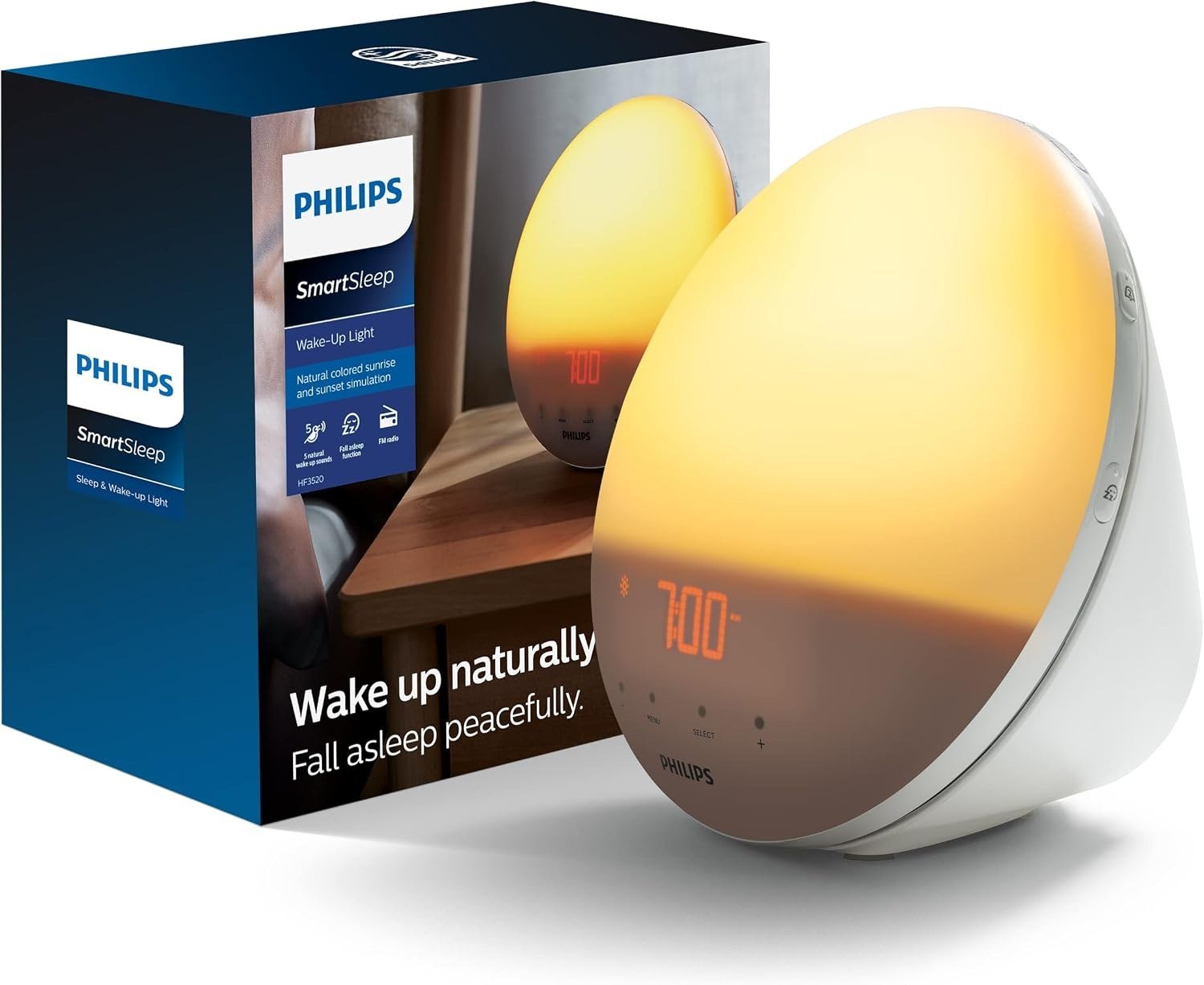
Philips SmartSleep Wake-Up Light HF3520/60
The Philips HF3520/60 is a dedicated wake-up lamp that brightens over 30 minutes through red, orange and yellow to a stated 300 lux, then plays one of five natural sounds or FM radio. It has a tap-to-snooze top, a sunset dimming mode and a reading-lamp function, and it needs no app. It suits people who want light as the wake cue and nothing to configure. It is an older design with a dated display and no white-noise library.
Psychological Reframing for Morning Motivation
While meticulously addressing the biological and complex endocrine aspects of waking up is undeniably foundational, permanently breaking the deeply ingrained snooze cycle also requires a profound, intentional psychological shift. The desperate urge to snooze is very often a clear symptom of a much broader misalignment between an individual’s daily, structured activities and their deep, intrinsic values or long-term goals. If the immediate prospect upon waking is a day filled entirely with dreaded tasks, excessive occupational stress, or a profound lack of underlying purpose, the brain naturally and defensively seeks to delay engagement with that harsh reality by retreating back into the safety of unconsciousness. This powerful psychological resistance vastly exacerbates the already difficult physiological struggle of sleep inertia, creating a powerful, self-perpetuating negative feedback loop that makes mornings feel completely insurmountable and deeply unpleasant.
To successfully overcome this psychological barrier, individuals must actively engage in intentional psychological reframing, specifically focusing on the deeply resonant concept of "ikigai," a Japanese philosophical term that roughly translates to "a reason for being" or, more practically, the specific, compelling reason one chooses to get up in the morning. Cultivating a strong, resilient sense of morning purpose requires intentional, quiet planning and active cognitive restructuring. One highly effective, evidence-based strategy is to deliberately decouple the physical act of waking up from the immediate anticipation of highly stressful daily obligations. Instead of allowing the brain to immediately default to a racing mental to-do list of anxieties upon hearing the alarm, individuals should carefully design and implement a "morning micro-reward" system. This involves scheduling a highly anticipated, very low-effort, and intrinsically rewarding activity to occur immediately after physically getting out of bed. This could be the ritual of brewing a high-quality specialty coffee, engaging in exactly ten minutes of reading a captivating fiction novel, practicing a brief, highly enjoyable stretching routine, or simply sitting quietly in bright natural sunlight. By deliberately placing a highly positive, deeply rewarding stimulus at the very beginning of the waking sequence, the brain begins to neuroplastically associate the act of rising not with impending, unavoidable stress, but with imminent, guaranteed gratification. This effectively leverages the brain’s powerful dopaminergic reward system to overcome the heavy inertia of the snooze button.
Furthermore, implementing "implementation intentions," a highly validated strategy drawn from cognitive-behavioral psychology, can be exceptionally effective in this context. This involves creating highly specific, inflexible "if-then" plans to pre-emptively overcome the strong physiological impulse to snooze. For example, "If the alarm rings at 6:30 AM, then I will immediately put my feet on the cold floor and stand fully upright." By deciding on the specific physical action well in advance, the individual completely bypasses the groggy, heavily impaired decision-making process that occurs during the peak of sleep inertia. The ultimate goal is to make the physical act of getting out of bed a completely automatic, entirely non-negotiable reflex rather than a daily, exhausting internal debate. Combining these sophisticated psychological strategies—cultivating deep morning purpose, designing immediate, highly salient micro-rewards, and establishing rigid, behavioral implementation intentions—with the robust biological interventions of gradual light exposure and perfectly consistent sleep schedules provides a comprehensive, incredibly robust framework for permanently breaking the snooze cycle. It fundamentally transforms the morning from a daily, dreaded battle against human biology into an intentional, highly motivated, and joyful launchpad for the rest of the day.
2-card wake-up setup
Build a gentler, more consistent wake-up setup.
-

Hatch Restore 3 — Putty
Best for
People building a phone-free wind-down and wake routine who want light, sound and alarm scheduled as one thing.
What it does well
- Light and sound are scheduled together in one bedtime and wake routine, which is the whole point of the category
- A large physical button and clock-face controls mean the phone stays out of the bedroom after set-up
Trade-offs
- Set-up requires the app, Wi-Fi and — per Hatch's own support pages — starting a free Hatch+ trial you then have to cancel
- Hatch+ ($4.99 a month or $49.99 a year per Hatch) is where the larger sound library, stories and meditations live
-
Philips SmartSleep Wake-Up Light HF3520/60
Best for
People who wake in the dark and want a bright, gradual light before the alarm, with nothing to set up or subscribe to.
What it does well
- A published brightness — 300 lux at the top of 20 settings — which neither Hatch nor Loftie states
- A 30-minute coloured sunrise that reaches full brightness before the sound, which is the whole idea of a wake light
Trade-offs
- A design that predates the current generation: the display and menus feel dated
- Five nature sounds and FM radio only — no white-noise library, no Bluetooth
-

Oura Ring 4
Best for
People who want long-term sleep and recovery trends without a screen on the wrist, and who will keep a membership.
What it does well
- No screen and no buzzing: nothing on the wrist to glance at when you wake at 3 a.m.
- Five to eight days per charge (Oura), so it is worn to bed every night rather than left on a charger
Trade-offs
- Membership: $5.99 a month or $69.99 a year per Oura; without it the app is restricted
- Sleep-stage estimates from a finger are estimates — useful for trends, not a diagnosis of anything
After explaining why repeated snoozing disrupts the wake-up routine; add a soft reminder near the conclusion.
Conclusion
The seemingly innocent, culturally normalized act of hitting the snooze button is, in biological reality, a significant, repeated physiological and psychological stressor that systematically sabotages our mornings and severely impairs our cognitive function for hours after rising. By deeply understanding the rigorous, complex science behind waking up, we clearly recognize that the transition from deep sleep to alert wakefulness is a highly delicate, highly orchestrated neurochemical and endocrine process that demands respect and precise circadian synchronization. The repeated, violent jolts of a traditional alarm violently fragment our vital REM sleep, plunge our cardiovascular system into a state of chaotic, unnecessary sympathetic arousal, and severely blunt the crucial, energizing Cortisol Awakening Response. This self-inflicted, chronic dysregulation guarantees profound sleep inertia, persistent chronic grogginess, and a severely suboptimal start to the day.
Breaking this deeply destructive, ingrained cycle requires a highly disciplined, multi-faceted approach grounded firmly in human biology and behavioral psychology. We must respect our innate circadian rhythms by ensuring adequate total sleep duration and unwavering consistency in our sleep-wake times. We must actively transition away from jarring, abrupt acoustic alarms that reliably induce the harmful fight-or-flight response, moving deliberately towards gradual, light-based dawn simulation systems that gently and naturally coax the brain into wakefulness, perfectly aligning with our evolutionary biology. Finally, we must actively couple these necessary physiological interventions with intentional, powerful psychological reframing, cultivating a deeply compelling sense of morning purpose and carefully designing environments that immediately reward the physical act of rising. By rigorously implementing these science-based, highly effective strategies, we can successfully conquer sleep inertia, permanently optimize our morning endocrinology, and reclaim the vital, vibrant energy necessary to engage fully and passionately with our lives from the very moment we open our eyes. The scientific evidence is absolutely clear and unambiguous: the most effective, biologically sound way to start the day is to silence the alarm exactly once, and rise immediately.

Join the conversation
Questions and experiences are welcome. Every comment is read by a person before it appears, and your email address is never published.
No comments yet — yours would be the first.