Category guide

Wake-up and circadian tools

These devices do two things a phone does badly: wake you with light rather than a jolt, and give you a reason to leave the phone outside the bedroom. Which one suits you depends on how much you want an app involved.

Before you buy

Do you actually need anything from this category?

Two free changes do more than any device here: the same wake time seven days a week, and daylight within the first half-hour of it. If your alarm is a phone, the case for a bedside clock is really the case for removing the phone — and a basic alarm clock does that. Buy a sunrise alarm when you wake in the dark for months of the year, when getting up is a struggle even after enough sleep, or when you want light and sound scheduled without touching anything. None of these devices treats a sleep disorder or resets a body clock by itself; they support a routine you keep.

Decision framework

How to choose

Ask three questions. Light or sound? If you wake in the dark, a bright, gradual sunrise is the feature (Philips publishes 300 lux; Hatch and Loftie do not publish a figure and are gentler). If you fall asleep to sound, the sound library matters more (Hatch, Loftie). How much app? None (Philips), set-up only then optional (Loftie, with a no-Wi-Fi mode), set-up and ongoing (Hatch). Subscription? Philips has none; Loftie's is optional with no trial pushed; Hatch's is optional but a trial starts during set-up.

Light output

Only Philips publishes a lux figure. If light is the wake cue, that number matters; if it is a tint, any of them will do.

Sound library

Hatch and Loftie carry white noise and nature sounds for the night; Philips has five wake sounds and FM radio.

App dependence

Whether the device works if the app, the account or the company goes away. Loftie's offline mode and the Philips's on-device menus are the independent options.

Subscription

What is free, what is paid, and whether set-up pushes a trial. All three work without paying; the details differ.

Phone-free operation

Physical buttons for snooze, off and routines. The device only earns its place if the phone leaves the room.

Bedside footprint and light spill

A lit clock face is light in a dark room; blackout and auto-dim modes are the fix.

The shortlist

Our picks, and why

As an Amazon Associate, SleepOriginal earns from qualifying purchases. Labels are editorial judgements — how they are decided.

Side by side

Every wake-up & circadian tools product at a glance

ProductBest forSubscriptionMain trade-offType
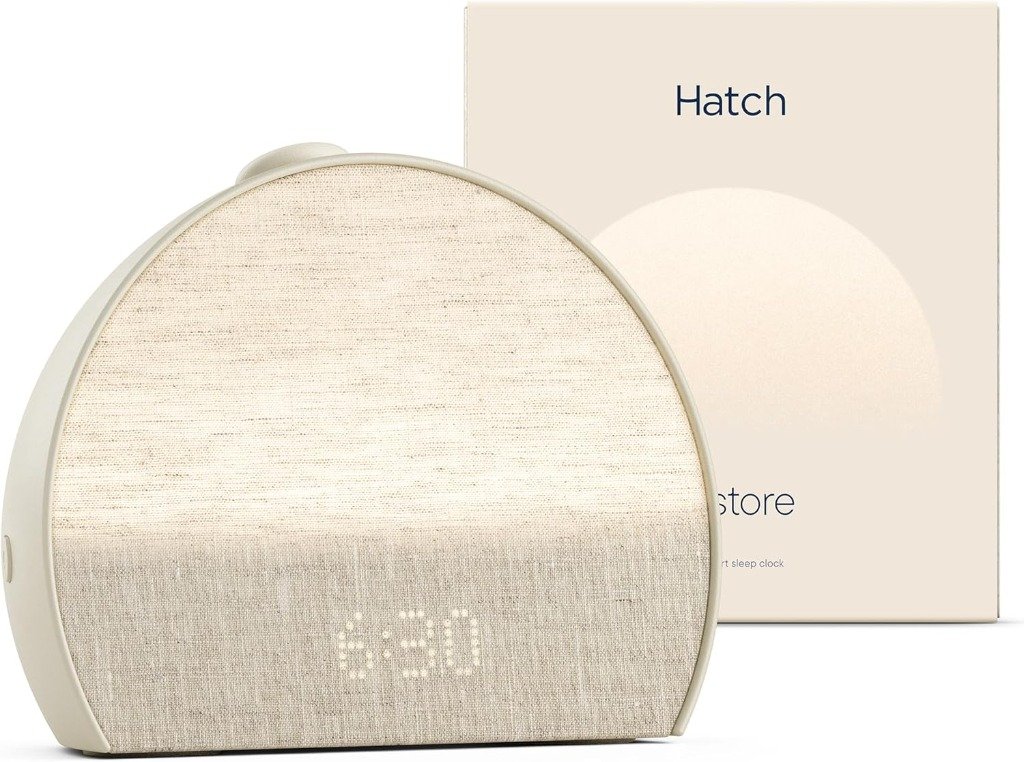
Hatch Restore 3 Phone-free bedtime and wake routines with light and sound scheduled together.Optional Hatch+ — $4.99/month or $49.99/year (Hatch); core features freeApp set-up with an opt-out trial, and the best content behind Hatch+. Sunrise alarm clock and sound machine
Loftie Getting the phone out of the bedroom without signing up for anything.Optional Loftie+; core audio free (Loftie)A modest light and speaker-only audio. Smart alarm clock with sound machine and Bluetooth speaker
Philips SmartSleep HF3520 Dark-morning wakers who want light as the cue and nothing connected.NoneA dated design with only five sounds and FM radio. Wake-up light with sounds and FM radio

Scroll sideways for the full table.

Narrow it down

Comparisons and buying guides

All reviews

Every wake-up & circadian tools review

Best routine-builder
Hatch Restore 3

The Hatch Restore 3 combines a colour sunrise/sunset light, a sound library and a phone-free clock face with a large snooze/off button. Set-up needs the Hatch app and Wi-Fi; nightly use does not. Around forty sounds, routines and alarms are free; Hatch+ adds more content for a monthly fee. It suits people building a phone-free bedtime and wake routine who want light and sound scheduled together. It is not a tracker, and the subscription is easy to sign up for during set-up.

Best forPhone-free bedtime and wake routines with light and sound scheduled together.

Best phone-free clock
Loftie

The Loftie is a compact bedside clock with a gentle two-phase alarm, over a hundred included sleep sounds, a nightlight and sunrise/sunset light, a Bluetooth speaker and a blackout display mode. After a Wi-Fi set-up it can run entirely offline. It suits people who want the phone out of the bedroom and dislike subscriptions and accounts. Its light is modest next to a dedicated wake lamp, and headphones are not supported.

Best forGetting the phone out of the bedroom without signing up for anything.

Best no-app wake light
Philips SmartSleep HF3520

The Philips HF3520/60 is a dedicated wake-up lamp that brightens over 30 minutes through red, orange and yellow to a stated 300 lux, then plays one of five natural sounds or FM radio. It has a tap-to-snooze top, a sunset dimming mode and a reading-lamp function, and it needs no app. It suits people who want light as the wake cue and nothing to configure. It is an older design with a dated display and no white-noise library.

Best forDark-morning wakers who want light as the cue and nothing connected.
Understand the problem first

Before the product, the cause

Questions

Wake-Up & Circadian Tools FAQ

Do sunrise alarm clocks work?

Gradual light before the alarm can make waking feel less abrupt and, for some people in winter, less groggy; the research is modest and effects vary. The more reliable benefit is practical: a fixed daily sunrise supports a fixed wake time, and a bedside clock lets the phone sleep elsewhere.

Which sunrise alarm does not need an app?

The Philips SmartSleep HF3520 is set entirely on the device. The Loftie needs the app for set-up and updates, then runs offline. The Hatch needs the app for set-up and for changing routines.

Which one needs a subscription?

None requires one. Hatch+ and Loftie+ are optional extras; Hatch starts a free trial during set-up that you can cancel. Philips has no subscription at all.

Can a wake light reset my body clock?

Not by itself. A consistent wake time and morning daylight are the strong signals; a wake light is a gentler alarm and a support for that habit. Persistent problems with sleep timing are worth discussing with a clinician.

SleepOriginal provides general educational information and is not a substitute for medical advice, diagnosis, or treatment. Persistent sleep difficulty, loud snoring or breathing pauses, severe daytime sleepiness, or symptoms affecting safety should be discussed with a qualified healthcare professional.