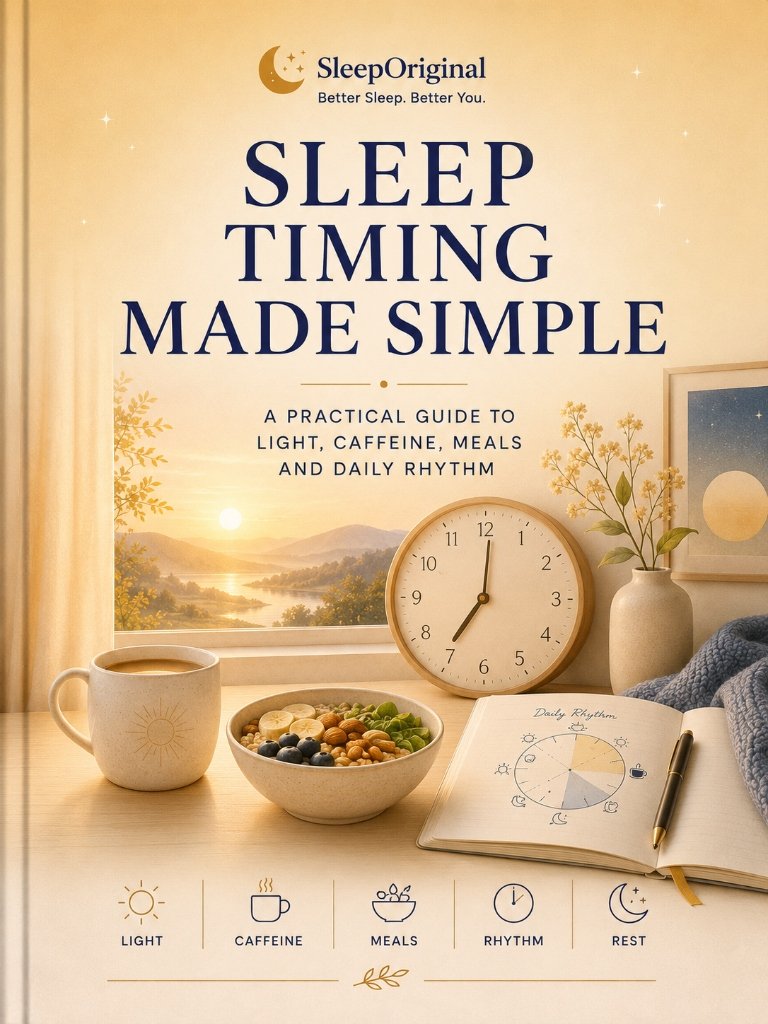
Sleep Timing Made Simple
A Practical Guide to Your Body Clock, Morning Light, Wake Time and a More Consistent Schedule
A practical guide to your body clock: wake time, morning light, finding your sleep window, and holding a schedule together through weekends, shift changes and travel.
PDF, available instantly — read on any device or print it
Why you need this
- Explains wake-time anchoring in plain language
- Useful for late chronotypes and after travel
- Works without any device or tracker
- Honest about what you can and cannot change about your natural timing
What's included
- A plain-language account of sleep pressure and the body clock, and how they interact
- How light sets your clock, and how to use morning light deliberately
- The wake-time anchor method, including how to survive the first week
- A process for finding your own sleep window instead of a prescribed bedtime
- Weekend drift: how much variation you can absorb
- Naps, deliberate schedule shifts, travel and clock changes
- A personal timing plan you complete as you read
- Delivered as a PDF to your Download Hub, straight after checkout
The Deep Dive
Two systems decide when you feel sleepy
Sleepiness is not one thing. There is the pressure that builds the longer you are awake, and there is an internal clock that decides when you should be awake at all. They usually cooperate. When they do not, you get the specific and frustrating experience of being exhausted at ten, wide awake at midnight, and unable to get up at seven.
Almost everything confusing about your own sleep timing makes sense once you can see both systems separately. That is what the first part of this guide is for.
Your body clock, and what sets it
Your internal clock runs on its own schedule and is adjusted mainly by light and dark. The guide covers how that adjustment works in practical terms — how much light, when, and why the light you get in the morning matters differently from the light you get at night.
Wake time before bedtime
The single most useful lever, and the least popular one. Bedtime is an outcome; wake time is an input. The guide explains why fixing the end of your night is what eventually moves the start of it, and how to hold a wake time through the awkward first week without wrecking yourself.
Finding your sleep window
Rather than prescribing eight hours at a fixed hour, the guide helps you find the window your own body is already pointing at, and covers what to do if that window is incompatible with the life you have to live.
Weekends and schedule drift
Two late nights can undo five consistent ones, which is why so many people feel worst on a Monday. The guide covers how much weekend variation you can absorb, and how to have a social life without resetting your clock every seven days.
Naps, travel and clock changes
When a nap helps and when it borrows from tonight. How to shift a schedule deliberately rather than by accident. What actually helps with jet lag and with the twice-yearly clock change.
Your personal timing plan
The guide ends with a written plan: your wake anchor, your light routine, your realistic window, and your rules for weekends and disruptions.
What this guide is, and is not
This is educational material. It explains what is known about everyday sleep behaviour and gives you a way to apply it, and it is written by a writer rather than a clinician. It does not diagnose anything and it is not a treatment for a sleep disorder.
If your sleep has been difficult for months, if you fall asleep easily but wake unrefreshed every day, or if anyone has told you that you stop breathing in your sleep, that is worth taking to a doctor. Persistent insomnia in particular has a recognised first-line treatment — cognitive behavioural therapy for insomnia — and it is more effective than habit advice. Nothing here replaces that.
Key Features
Two systems, explained separately
Pressure and clock.
Most confusion about your own timing dissolves once you can see sleep pressure and the body clock as two different things that sometimes disagree.
Wake time as the lever
Bedtime is the outcome.
Fixing the end of your night is what eventually moves the start of it. The guide covers how to hold a wake anchor through the difficult first week.
Your window, not a prescription
No fixed eight hours.
Helps you find the window your body is already indicating, and deals honestly with what to do when that window does not fit your obligations.
Weekends without a reset
A social life included.
How much weekend variation you can absorb before Monday costs you, and how to plan late nights so they do not undo the week.
Technical Specifications
| Format | |
|---|---|
| Language | English |
| Delivery | Instant download via your SleepOriginal Download Hub after checkout |
Frequently asked questions
I am a night owl. Can I actually change that?
Partly. Your natural timing has a large fixed component, and the guide is honest that you are unlikely to become a morning person by choice. What you can usually shift is the gap between your body clock and the schedule you are obliged to keep, which is where most of the discomfort comes from.
Does this cover shift work?
It covers deliberate schedule shifts and travel, which share the same mechanics. It is not written specifically for rotating shift patterns, and anyone working nights long-term should treat it as background rather than a plan.
How is this different from Morning Light, Better Nights?
The free guide gives you a morning light routine to try. This book explains the system that routine works on, and covers wake time, sleep window, weekends, naps and travel as well.
Do I need a light therapy lamp?
Usually not. Daylight outdoors is stronger than most indoor lighting even on an overcast day, and the guide works through free options first. It covers where a lamp genuinely earns its place, such as dark winters and pre-dawn starts.
What format is it, and how do I get it?
A PDF, delivered to your SleepOriginal Download Hub immediately after checkout.
Educational Disclaimer: SleepOriginal provides general educational information and practical self-guided resources. It is not medical advice, diagnosis, or treatment. People with persistent or concerning sleep difficulties should speak with an appropriately qualified healthcare professional.
Not ready to buy? Start with Morning Light, Better Nights, free.
Need the complete SleepOriginal system? SleepOriginal Complete Toolkit
Ready to improve your sleep?
Get instant access to Sleep Timing Made Simple and start your journey tonight.
Join the conversation
Questions and experiences are welcome. Every comment is read by a person before it appears, and your email address is never published.
No comments yet — yours would be the first.